When the executive leaves, the institution keeps what they knew.
Executives leave and roles change. The authority they held passes to someone else, usually through a partial briefing and a few documents. MagnaRix makes the handover a deliberate, recorded act, including the positions, open questions, and borne judgments the departing person carried with them.
A deliberate, recorded act
Authority Handover in MagnaRix makes the transfer of authority a deliberate, recorded act. When a person departs from an authority position, the handover captures not only what is being transferred but everything being inherited along with it.
The incoming executive does not have to reconstruct the institution's positions from scratch. They inherit the positions in force, the open tensions in play, the borne judgments standing behind decisions in this domain, and the institution's standing as it was at the moment of transfer. The person changes; the institution's position in the domain does not.
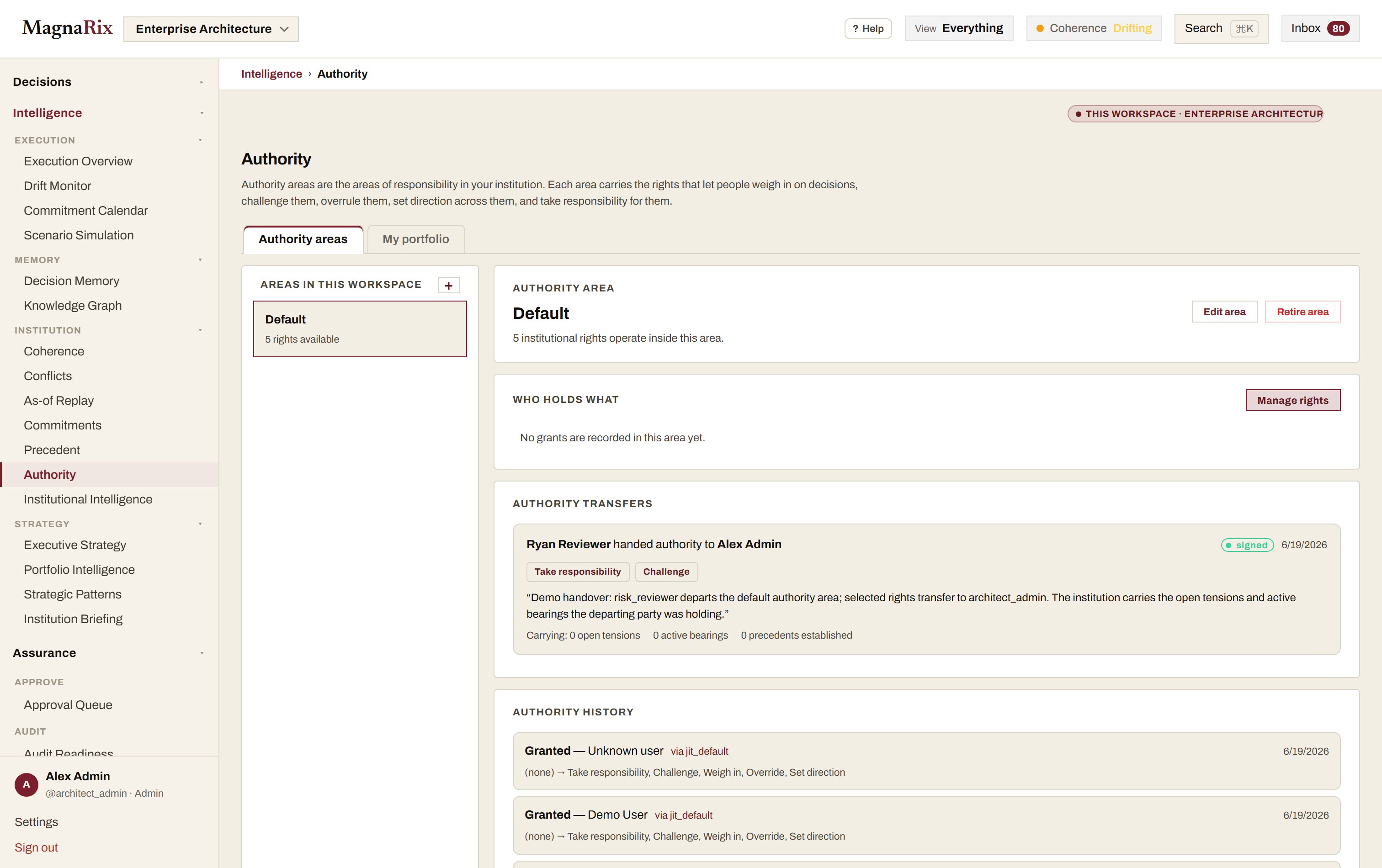
What is transferred in a handover
The departing and receiving parties
Who is leaving the authority position, who is taking it, and when the transfer occurs. Recorded with the same permanence as the authority structure itself.
The authority being transferred
The specific rights the position carries: to interpret, challenge, reframe, synthesize, or carry consequential decisions in this domain. The incoming person inherits these explicitly, not by inference from a job title.
Positions in force
What the institution currently holds in the domain, registered as established institution doctrine. Described further in Institutional Precedent.
Open questions and tensions
The questions the departing person was actively managing: where the institution's position is under pressure, where a decision is forming but has not yet been made. The incoming person inherits these as live matters, not surprises they discover later.
Borne judgments still in force
The consequential decisions whose Judgment-Bearing is still active in the domain, attributed to who carried them. The incoming person inherits the institution's standing behind these calls, with full awareness of what was accepted at the time.
Institution position and exposure
A practical account of what the institution is doing in this domain and why: where commitments are concentrated, where assumptions are most exposed, and where alignment with other parts of the business currently rests.
Continuity as a property, not a hope
Leadership turnover is one of the most consistent pressures on an institution's ability to hold its positions. Executives leave, boards refresh, and senior leaders move on. Each transition normally opens a months-long reconstruction period in which the new person is unsure what they have actually inherited and the institution's holding of authority is weaker than anyone realizes, mitigated only by what gets passed on informally before the person walks out the door.
Authority Handover changes the form of what passes. The incoming person arrives into the institution's full record rather than a partial reconstruction of it, with the inheritance legible from day one: positions in force, open questions, borne judgments still active, and the current state of the domain. Continuity becomes something the institution preserves by design rather than something that depends on the departing person's conscientiousness, because the institution preserves what it held, not only who held it. The full account of how an institution's positions remain coherent across time and personnel change is given in Continuity Intelligence.