Your institution makes important decisions every day. Most of them leave no usable record.
When a regulator asks, when a board questions the reasoning, or when a program fails and nobody can trace who made the original call, the gap is the same: no system was ever built to hold the decision itself.
Why the tools you already have don't solve this
Institutions use many tools that touch decisions, yet the decision itself is rarely what any of them hold. Each covers a piece of the problem while leaving the core gap open.
Document management and wikis
Store outputs, not reasoning. Documents are rarely structured. There is no lifecycle, no approval model, and no way to search for a decision by the question it answered. Text is not a decision record.
Project management platforms
Organize work, not decisions. The decision that justified the work rarely lives in the tool that managed it. When projects close, whatever decision record existed disappears with them.
Meeting and collaboration tools
Support communication, not documentation. What was discussed and what was decided are different things. Action items are tracked; the reasoning behind them is not.
General-purpose AI assistants
Produce drafts and summaries, not governance. AI assistants can help analyze or summarize, but they provide no approval chain, no traceability, and no auditable record. An AI response is not an accountable decision.
Business intelligence platforms
Deliver data, not decisions. BI tools surface information for decisions but do not capture what the institution did with it: what was considered, what was concluded, or who was accountable.
GRC and compliance tools
Track risks and controls, not decision history. Governance in these tools is a certification activity. They record what was approved; they do not preserve why, under what reasoning, or by whom the call was actually carried.
Decision records, approval, and AI governance belong in the same system.
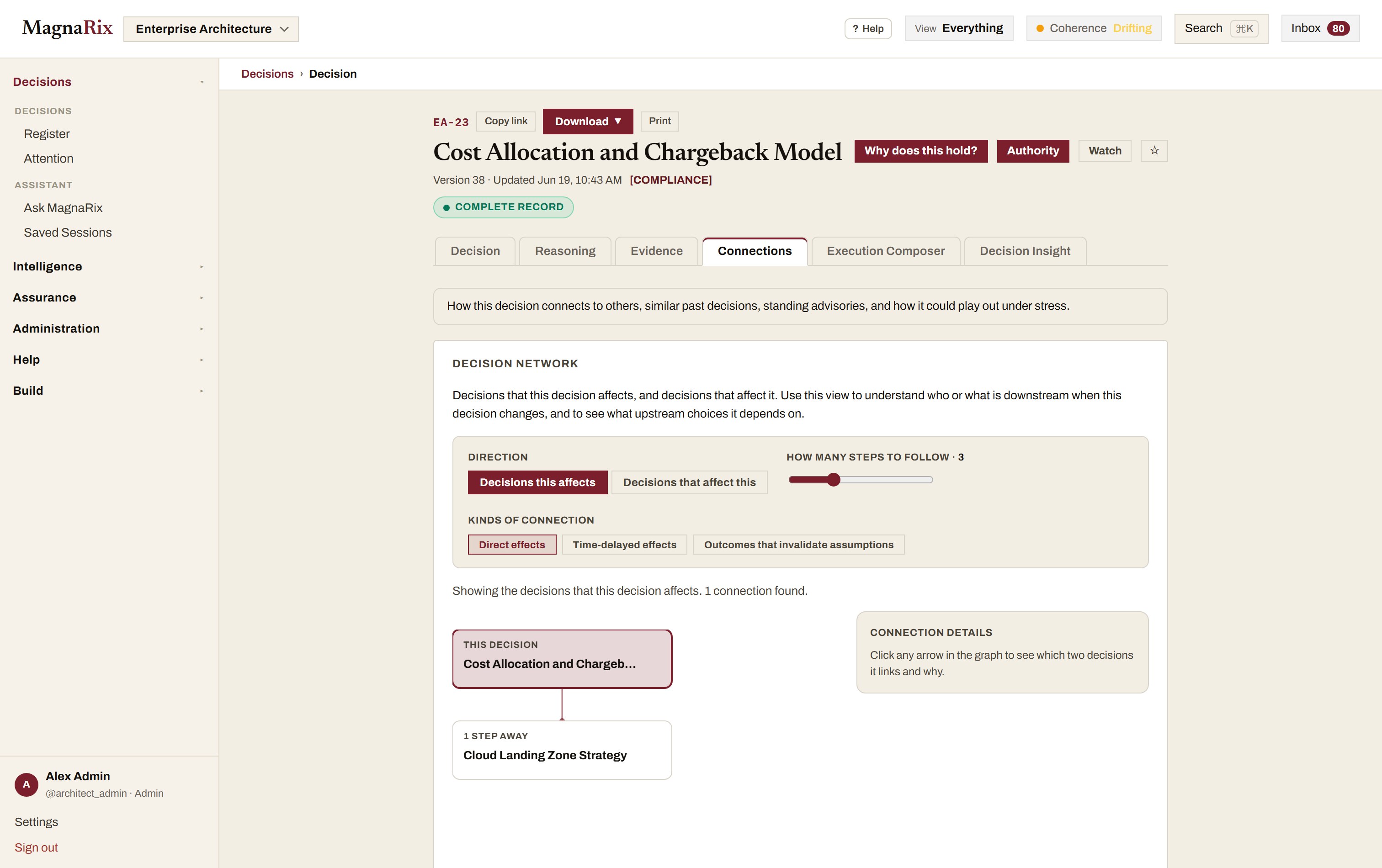
MagnaRix brings together several capabilities that only work when they are held together, and shows them on any decision in a single view:
Decision Memory
A structured, durable, governed record of decisions that persists beyond the people who made them and is accessible in controlled ways across the institution.
Governance
An approval model built into the decision itself: decision rights, review steps, and accountability chains are explicit in the record, not separate from it.
Advisory Intelligence
AI assistance that participates inside the governed decision process, contributing analysis with full attribution and traceability. Every AI action is bounded by your approval structure and auditable.
Coherence
Whether the institution's decisions still hold together, computed continuously: when an assumption is challenged, every decision that depends on it is flagged to reconsider, and drift between intent and execution surfaces before it compounds.
Judgment-Bearing
The act of carrying a consequential decision under uncertainty, preserved as part of the record alongside the approval that authorized it, and weighed by the bearer's track record on past calls.
Institutional Precedent
The positions prior decisions have established, preserved as a continuous record the institution can apply, distinguish from, or set aside with full awareness of what it is departing from.
Continuity Intelligence
The ability to see how your institution's positions have shifted across time: where assumptions have decayed, where prior commitments are no longer reflected in current positions, and where the record remains sound.
What this problem repeatedly surfaces
- ✓A record of why we made this decision, with the reasoning intact
- ✓A way to verify that the right people were in the approval chain
- ✓The ability to reconstruct decision history for audit and regulatory review
- ✓A way for decisions to survive leadership and team transitions
- ✓A governed, auditable way to involve AI in important decisions
- ✓Consistency in how decisions are documented and approved across the institution
- ✓Access to the reasoning behind past decisions, so the same assumptions and failures are not repeated blindly
A note on category definition
Decision infrastructure names a capability that enterprise systems have rarely treated directly. It has been dispersed across documents, workflows, approval forums, and individual memory. MagnaRix brings it together: your institution's decision record, approval chain, borne judgments, established positions, and AI contributions, held within a single governed system.
The moment of recognition
This work does not begin in procurement. It begins in specific moments that senior executives recognize: the CEO who realizes the institution cannot reconstruct the reasoning behind a major decision made before their tenure, and that the people who could are no longer present. The CTO asked to defend a foundational platform choice the institution can no longer explain. The head of risk who discovers the institution has drifted from a position it once held clearly, with nobody having noticed while the drift was forming. The chief of staff to a leader who has signed many approvals but is increasingly unsure which of those decisions the institution actually stood behind.
These are not technology problems. They are institution conditions that have become structural. The executives who recognize this work are those who have begun to see that none of the systems they currently operate was built to hold the continuity of important decisions. This work is most consequential for institutions whose decisions accumulate weight over years: regulated enterprises, institutions under board scrutiny, organizations running multi-year transformations, and institutions integrating AI into decision-making faster than their governance was designed to handle.
What changes once decisions are preserved as infrastructure
The shift is not in tooling. It is in what the institution preserves about itself. Several specific changes follow.
Decisions remain reconstructable
When a regulator, board, or new executive asks why a decision was made, the institution can show its reasoning rather than reconstruct it from scattered artifacts.
Approval is consistent
The approval steps a decision requires are explicit and the same across the institution, rather than improvised case by case.
AI participates inside the approval process
Every AI contribution is attributed to the model, bounded by the same rules that govern people, and reviewable in the record.
Judgment-Bearing is explicit
When a consequential decision is made under uncertainty, the institution knows not only who approved it but who carried it.
Prior positions are inherited, not rediscovered
New decisions start from what the institution already holds, rather than reconstructing its position from documents each time a similar question returns.
Authority passes deliberately
When people change roles, what is being inherited (positions in force, open questions, borne judgments still active) passes with the authority itself, not after months of informal reconstruction.
Drift becomes visible
The institution can see where its positions have shifted and where its assumptions have decayed, in the record, before the shift produces an audit finding or a board question.
Institutional Commitments are tracked
Forward-looking obligations accepted as a condition of acting are tracked alongside the decisions that authorized them, visible to the institution before they become visible to anyone else.
Where this is going: Depth