Where an unanswered decision gets expensive.
These are the places where, sooner or later, someone makes you account for a decision: AI in your decisions, regulated work, large programs, capital calls, and the choices that span the whole institution.
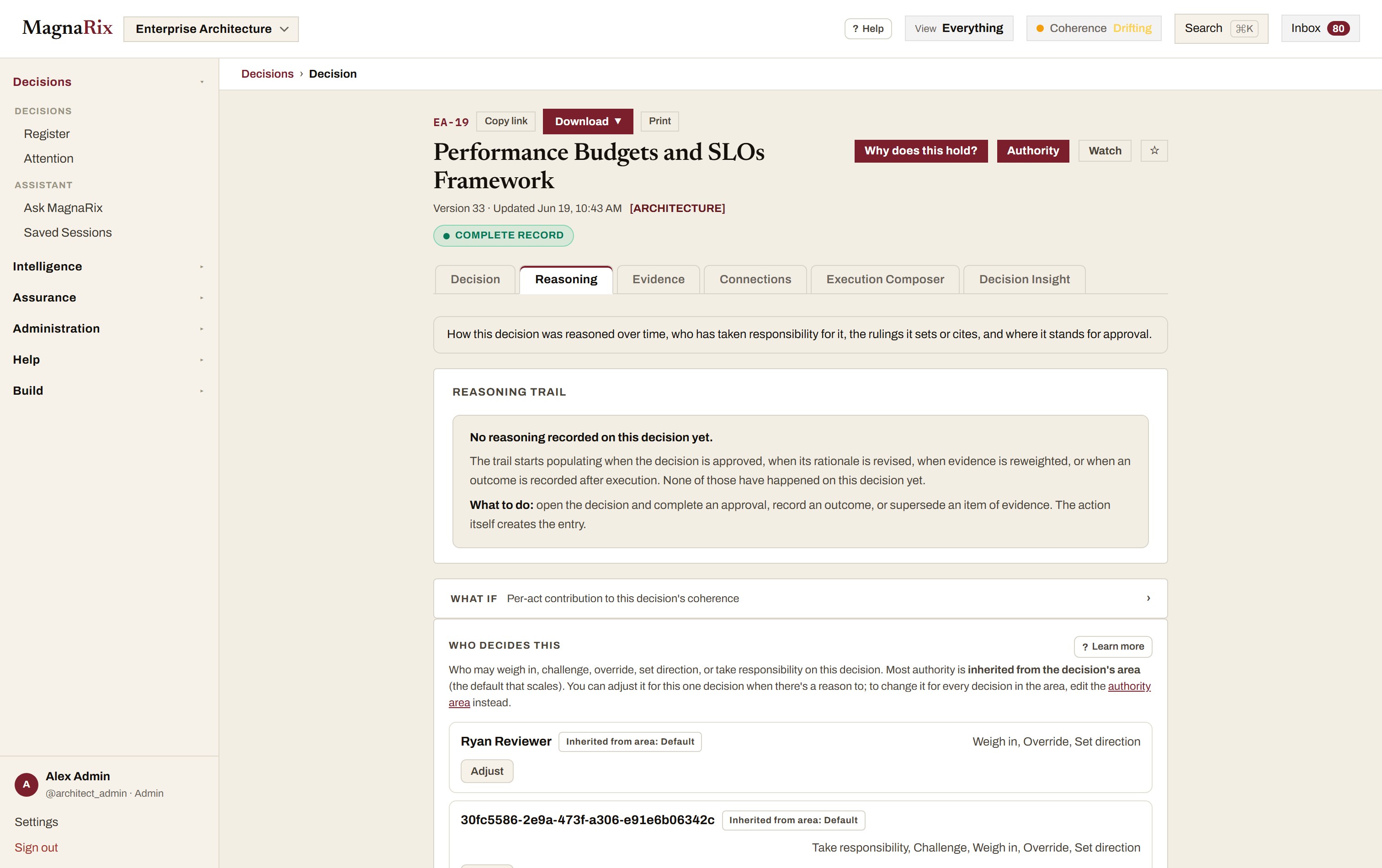
Every AI-assisted decision on the record
The Challenge
AI is weighing in on real decisions across the business, usually outside the approvals that govern what your people do. Its output moves a decision along with no one named against it and no link back to whoever should have signed off. The first time one of those decisions is challenged, you cannot fully reconstruct or defend it.
How MagnaRix Helps
MagnaRix puts the AI in your decisions under the same approvals as your people: every contribution attributed to the model, on the record, and reviewable by anyone who can reopen the decision.
The full treatment is in AI Governance: how AI takes part in Advisory Intelligence, and why the responsibility for a hard call stays with the person who makes it in Judgment-Bearing.
What Becomes Better
When a board or regulator asks what the AI did and who stood behind the result, the answer is already on file. AI speeds the work up without scattering it across tools no one can later piece together.
A reconstruction that is already done
The Challenge
In regulated sectors, being able to reconstruct the reasoning behind a decision is not optional; it is a requirement. Most institutions cannot produce that record reliably from decks, emails, and meeting notes, so an inquiry turns into a scramble.
How MagnaRix Helps
MagnaRix keeps a structured, auditable record of each decision: the evidence consulted, the risks weighed, the people who approved it, and the rationale applied. Audit-readiness becomes a property of how you work, not a project you launch when the regulator calls.
How the institution stays consistent when many people are deciding at once, which audit can verify, is covered in Institutional Coherence.
What Becomes Better
A regulator or internal audit gets a clear, searchable record on request. Compliance can show the decision process was followed, and every risk decision traces back to the conditions that produced it.
Programs that stay tied to what was approved
The Challenge
A large program runs on hundreds of decisions made by different teams and sponsors over years. The records scatter across program docs, steering minutes, and delivery tools, and the program drifts from what was actually approved until it fails late and no one can point to where.
How MagnaRix Helps
MagnaRix keeps each program decision connected to the work it authorized and to the decisions around it. Program boards can see how choices connect, where assumptions need re-examining, and where delivery has diverged from intent.
Watching how a program's positions hold or move over time is covered in Continuity Intelligence, and the forward-looking commitments in program decisions in Institutional Commitments.
What Becomes Better
Continuity survives sponsor and team changes. Divergence shows up as drift while you can still correct it, and the reasoning behind early choices is recoverable when later conditions challenge them.
Capital decisions you can defend later
The Challenge
Investment committee and portfolio decisions often lack a structured record of how options were weighed, what criteria applied, what risks were accepted, and what would trigger a review. Over time that makes the portfolio reactive instead of deliberate, and hard to defend when a bet goes wrong.
How MagnaRix Helps
MagnaRix gives portfolio governance a structured record: decision canvases for investment commitments, stage-gate calls, and portfolio reviews, with health and risk rolling up across them and stress scenarios surfacing fragility before it bites.
The forward-looking side of portfolio commitments is covered in Institutional Commitments.
What Becomes Better
Portfolio reviews are grounded in real decision history. Stage-gates reference the prior rationale directly, and the line from strategy to where the money went is traceable.
Cross-functional calls with clear authority
The Challenge
Decisions that cross functional lines, between technology and operations, finance and strategy, product and risk, are among the most consequential and the most poorly governed. Authority is ambiguous, accountability is diffuse, and the result reflects negotiation more than reasoning.
How MagnaRix Helps
MagnaRix makes authority explicit inside the decision: who decides, who advises, who is informed, and what the escalation path is. The authority structure lives in the decision itself, not in someone’s head.
This is covered more fully in Governance & Approval.
What Becomes Better
Cross-functional decisions are made with documented authority and unambiguous accountability. Reviews can confirm the right governance was applied to the right decisions.
Strategic bets with the reasoning preserved
The Challenge
Leadership teams run scenario analysis and directional calls with large consequences, but the discussion usually ends in an informal conclusion. Months later it is unclear what was actually decided, by whom, and on what basis, just as conditions start to shift.
How MagnaRix Helps
MagnaRix captures each scenario, its assumptions, its options, and the reasoning behind the path chosen. The alternatives and their analysis are kept alongside the final call, ready to revisit as the world changes.
What Becomes Better
Strategic decisions are recorded with the rigor their stakes warrant. When the market moves, leadership can return to the original analysis, see which assumptions broke, and act on what follows.
Architecture choices that outlive the architects
The Challenge
Architecture teams make choices that shape the technology landscape for years: platforms, integration patterns, data architecture, conventions. They are usually captured in slide decks that do not survive the people who made them, so the next team inherits the outcome without the reasoning.
How MagnaRix Helps
MagnaRix gives each significant architectural decision a structured record: the options, the trade-offs, the principles applied, the authorities engaged, and what the AI contributed. Architecture decisions become searchable, linked, reviewable assets instead of lost documents.
What Becomes Better
Incoming architects inherit the reasoning, not just the result. Architecture reviews can examine how a decision was reached, and governance can confirm it was made with rigor.
Judgment that does not leave with the person
The Challenge
When an experienced leader, architect, or expert leaves, they take the history of decisions they shaped: why the institution made certain structural choices, what was considered, and what positions made those choices sensible. The loss is rarely measured and consistently expensive.
How MagnaRix Helps
MagnaRix keeps both the decisions and who carried them. When someone transitions out, the handover is a deliberate act that passes on the positions in force, the calls still active, and the open questions being managed, to whoever takes the role.
How authority transfers across personnel changes is covered in Authority Handover.
What Becomes Better
Incoming people inherit documented reasoning and the standing the institution has built, not just the outcomes. Knowledge continuity becomes something you manage, instead of resetting with every departure.